
Click to read more about the critical gopher tortoise conservation being done across the species' range in our 2025 state and committee report summaries.
Alabama
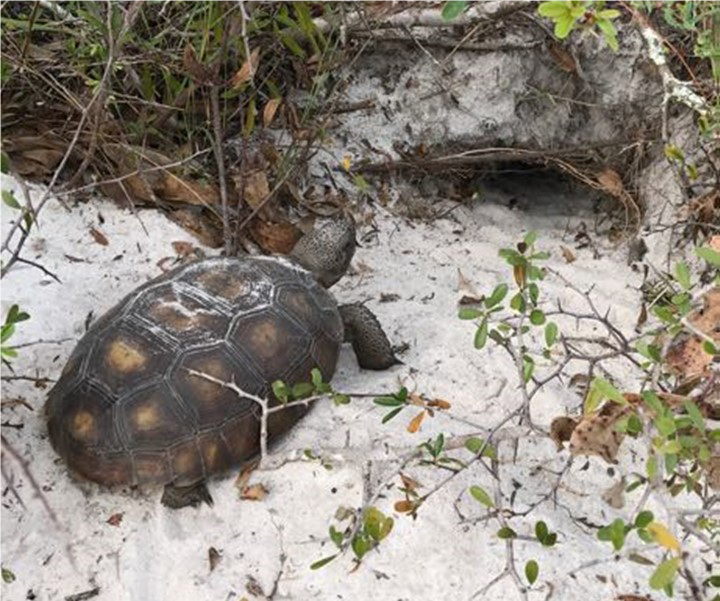
DWFF continues to work towards determining a more accurate gopher tortoise population estimate and distribution in Alabama. In Alabama, roughly ninety-five percent of the gopher tortoise habitat is in private ownership. The remaining percentage of land holdings are owned by state or federal agencies. Private land surveys are needed to determine accurate gopher tortoise population estimates and distribution. Ongoing efforts continue with private landowners by conducting site visits and discussing gopher tortoise habitat and conservation goals.
Florida
Research & Monitoring
This year brought several notable developments across long-term gopher tortoise research sites. On Egmont Key, post-hurricane assessments continued following last fall’s displacement event, when many tortoises washed ashore along the Pinellas coastline. A small group of survivors has since established on Fort De Soto. The remaining Egmont population is now heavily skewed toward adult females, and researchers are continuing demographic and health monitoring. At Boyd Hill, work is ongoing in response to the coyote-driven mortality event; although some coyotes have been removed, a few remain on the landscape. At Archbold, researchers documented an uptick in suspected Upper Respiratory Tract Disease (URTD) within the long-term Red Hill study population. Approximately 60 tortoises have been swabbed, and a subset is receiving repeated health evaluations as part of an FWC-supported study.
Wildlands Conservation
The “Protect the Gopher Tortoise” specialty license plate is approaching its first-year requirement, with roughly 2,500 plates sold toward the 3,000 needed by April. Wildlands also finalized a statewide GIS model that ranks areas where habitat surveys should be prioritized prior to development. Statewide relocation numbers have stabilized at 8,000–11,000 tortoises moved annually, totaling more than 111,000 since 2009. Authorized Agent training also remains in high demand.
Land Policy & Conservation Issues
Several policy and land-management issues emerged this year. Proposed land swaps at both Guana River WMA and Twin Rivers State Forest were withdrawn following strong public opposition, underscoring the continued importance of stakeholder engagement. Senate Bill 80 passed after the controversy at Jonathan Dickinson State Park and now prohibits commercial development—such as hotels or golf courses—within state parks. Florida Forever funding was reduced to $18 million this fiscal year, creating added challenges for acquiring priority conservation lands even as demand for protection grows.

Georgia
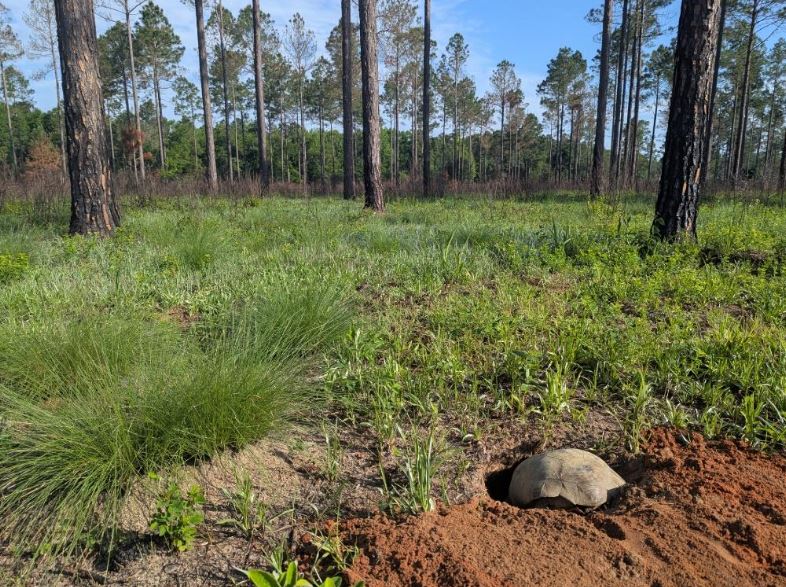
This year, Georgia’s Gopher Tortoise Conservation Initiative met its intended goal of permanently protecting 65 minimum viable tortoise populations (MVPs) across the state. This has been a major accomplishment that involved many partners working in Georgia to protect approximately 138,000 acres across 24 different sites since the Initiative began in 2015. GADNR’s Gopher Tortoise Fire Crew burned 5,671 acres of quality gopher tortoise habitat and biologists installed soft release pens on Chickasawhatchee WMA and Chattahoochee Fall Line WMA to serve as recipient areas for waif gopher tortoises. Through intentional management, Chickasawhatchee WMA has even become a release site for gopher frogs and red-cockaded woodpeckers in the last year.
The Orianne Society (TOS) continues to monitor Eastern Indigo Snakes at over 60 potential sites across southeastern Georgia using an occupancy monitoring framework and collecting mark-recapture data to estimate demographic rates from these populations. TOS is also collecting indigo snake tissue samples and working to integrate Georgia monitoring data with that of reintroduced indigo snake populations in Florida and Alabama. Tall Timbers Research Station will be resurveying quail properties in the Red Hills of Georgia beginning in 2026. Jade Samples and Eva Kerr, working with the Jones Center at Ichauway and the University of Georgia successfully defended their MS theses on “Habitat Restoration and Translocation for Threatened Amphibians in Georgia” and “Metapopulation Dynamics of Gopher Frogs in Georgia”, respectively.
Headstarting efforts continue with the Warm Springs National Fish Hatchery and the University of Georgia Coastal Ecology Lab (part of Marine Extension and Georgia Sea Grant). Most headstarted tortoises are released at WMAs to augment populations, but some are released onto reclaimed mine lands. UGA continues to work on solutions for impact reduction and improved conservation actions with industry, mineral mining and large-scale utility solar, in particular. In 2025, they released 17 headstarts on to Penholoway WMA, which happened as part of filming an episode with Wild Kingdom and the UGA-Coastal Outreach Soccer youth/young professionals program, YoPro, airing Spring 2026.
Louisiana
Louisiana is the only state in the gopher tortoise range without an established Minimum Viable Population (MVP; ≥ 250 adults on 100ha of high quality habitat). Ten support populations have been documented on Sandy Hollow WMA, Lee Memorial Forest, and industrial and non-industrial timberlands combined, with the majority located on pipeline and powerline right-of-ways. Sandy Hollow WMA is the only public land that currently houses a reproducing population of the species on optimal habitat in Louisiana. However, progress with conserving and expanding populations on industrial and non-industrial timberland has continued with prescribed burning in 2025. The Louisiana Department of Wildlife and Fisheries (LDWF) is working towards bolstering existing support populations via habitat restoration and management, head-starting, population augmentation and land acquisition, with a goal of creating Louisiana’s first MVP. In partnership with University of New Orleans (UNO), Weyerhaeuser Company, and U.S. Fish and Wildlife Service (USFWS) Natchitoches National Fish Hatchery, LDWF is continuing head-starting efforts with 14 hatchlings from nests detected in 2025 within the state’s two largest support populations.
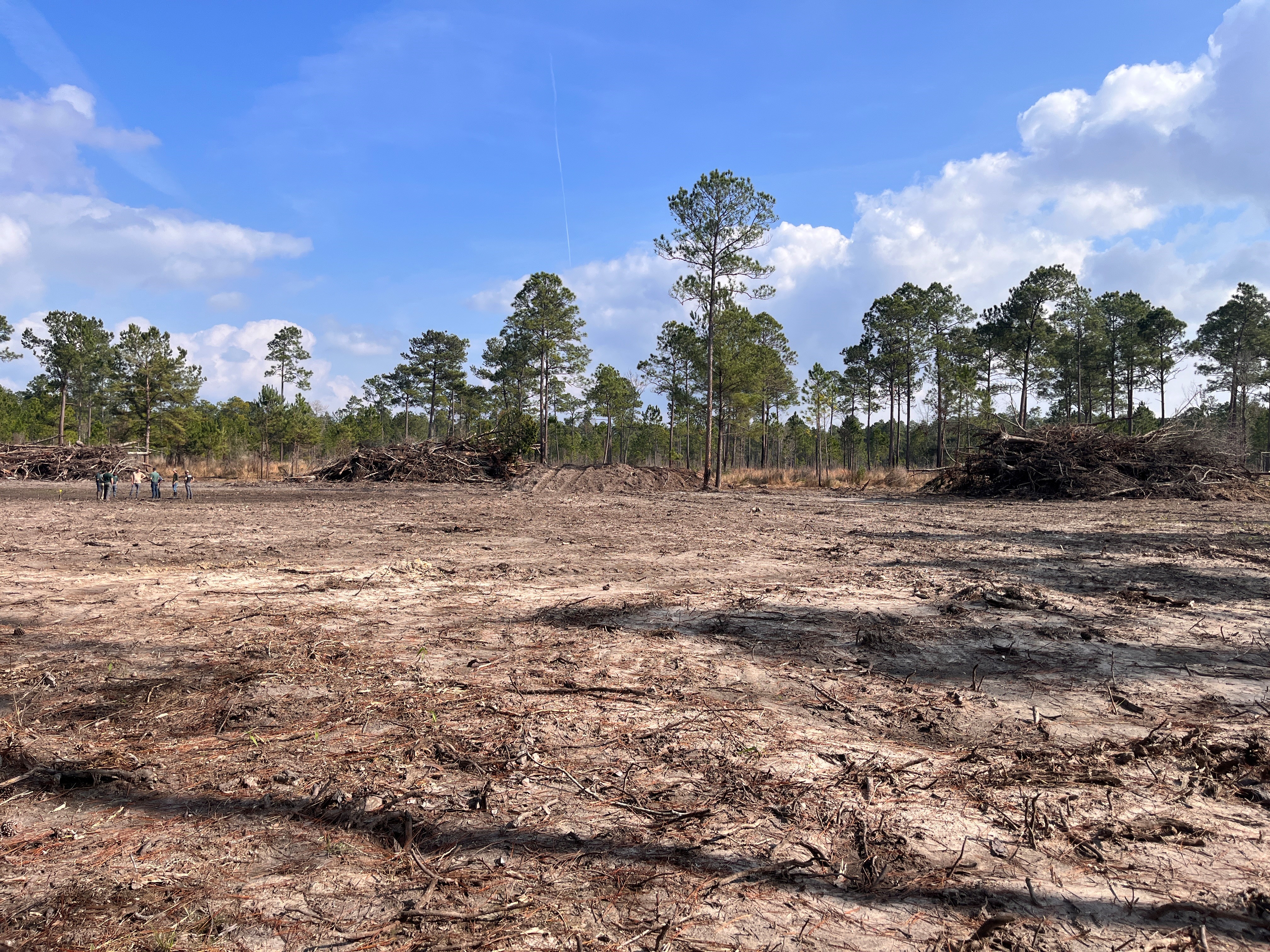
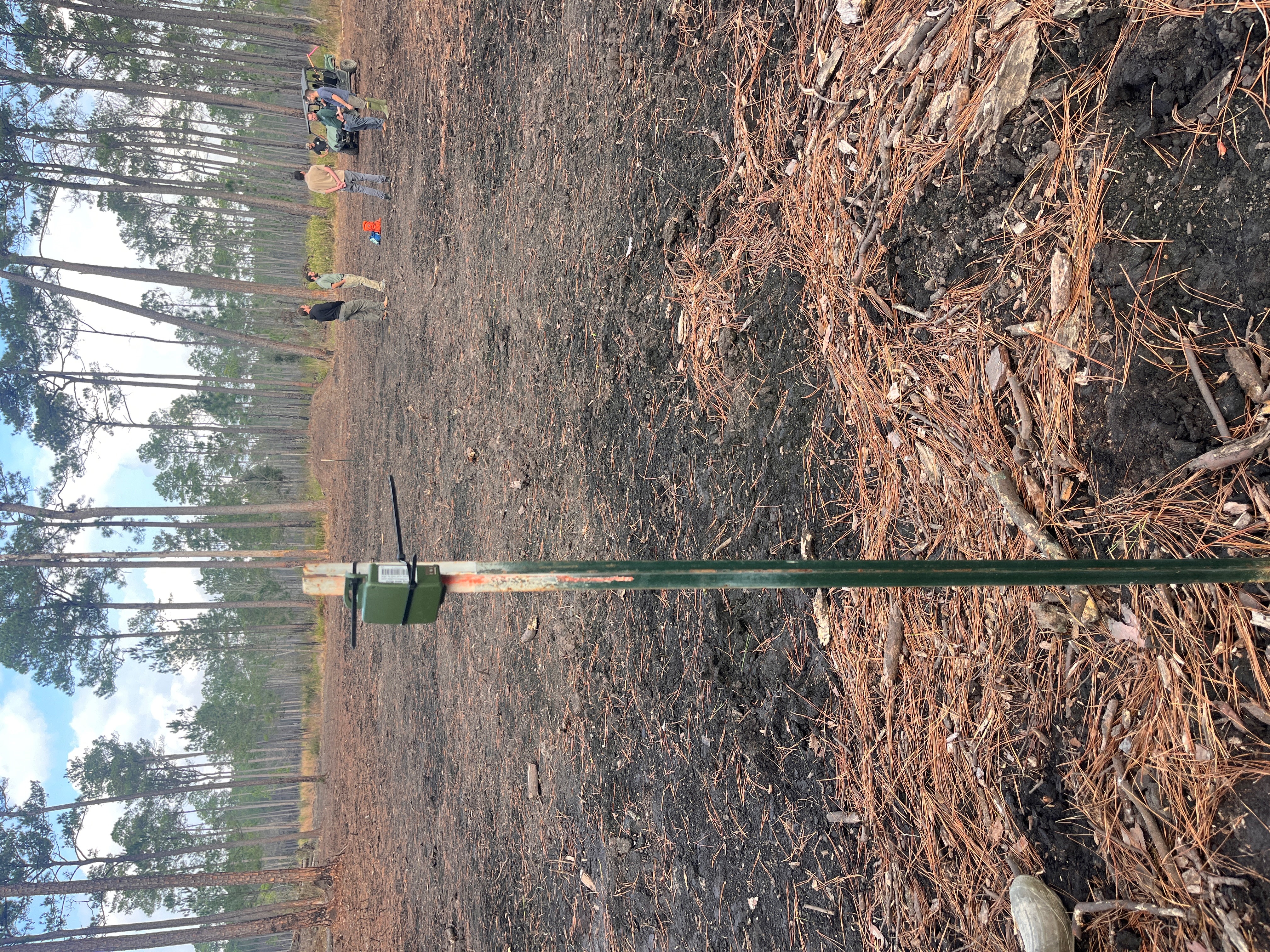
In 2025, LDWF, in partnership with the Trust for Public Land, acquired the Bogue Chitto WMA, which is adjacent to the Bogue Chitto State Park (BCSP). Through this partnership initiative, the Louisiana Office of State Parks (LOSP) also acquired additional acreage added to the existing BCSP boundary and LDWF is assisting the State Park with longleaf pine restoration on the new acquisition. In addition, LDWF intends to restore longleaf pine on suitable soils on Bogue Chitto WMA.
In 2022, LDWF staff began a comprehensive review of the state’s reptile and amphibian regulations to identify deficiencies and necessary updates. Subsequently, a Notice of Intent (NOI) was developed and presented to the Louisiana Wildlife and Fisheries Commission in 2023. LDWF staff requested Commission approval of the NOI that would establish regulatory language to aid in the conservation and protection of reptile and amphibian resources within the state. LDWF’s revised reptile and amphibian regulations, including burrow protection for the gopher tortoise, were officially enacted on January 20, 2025 (https://www.wlf.louisiana.gov/assets/Licenses_and_Permits/Files/Reptiles-and-Amphibians-Rule-State-Register-Jan-2025.pdf).
LDWF and multiple partners, including USFWS, U.S. Geological Survey, The Nature Conservancy, Audubon Nature Institute, Mississippi Department of Wildlife, Fisheries, and Parks, Western Carolina University, and Sustainable Forestry Solutions, have been working on pond restoration efforts for dusky gopher frog reintroduction in Louisiana. In November 2025, habitat improvements were conducted on two ephemeral ponds in St. Tammany parish with hydrology and anuran occurrence being monitored to evaluate restoration success.
Mississippi
With the help of the USFS and the USFWS we continued to collect Gopher Tortoise eggs for headstarting. We are in the third year of egg collections and have just released the second batch of two year old headstart tortoises this September. We released 65 juveniles this year bringing the total to 110 juvenile tortoises to help supplement the numbers and genetic diversity of the established colony at the site. We intend on selecting a new release site for next year. We collected 102 Gopher Tortoise eggs this nesting season, the highest number of eggs so far! Most of those eggs came from Desoto National Forest lands but a few private properties provided eggs as well.
We have also continued consolidating waif and solitary tortoises from around Desoto National Forest and unmanaged private properties. I received roughly 15 calls from citizens regarding roadside or problematic tortoises this year. Many of these tortoises qualified for removal and placement into translocation pens. The FS has also started trapping tortoises from FS units that do not receive fire anymore and moved them to translocation pens. We ran out of pens and space again. We are looking into new areas to build more pens to establish colonies and/or help established colonies.
The Gopher Tortoises in Mississippi all suffer from the same problems. The burn regime in a very large portion of the forest is not adequate for a Gopher Tortoise population to thrive. Most areas that should be burned every 1–2 years often don’t get fire for more than 4–5 years. We are working with the FS to try and find solutions to the burning problem.
South Carolina
Aiken Gopher Tortoise Heritage Preserve (AGTHP)
Waif and headstart tortoises continue to be released at the AGTHP. An MOA with Florida FWC has largely facilitated restocking with waifs. This year we added 34 waifs (26 FL FWC), 26 two year old headstarts and currently estimate this population close to 250 adults (Headstarting SREL-UGA with support from Longleaf Alliance). This year approximately 208 acres were burned (dormant) and 337 acres (growing season). 225 acres were treated with herbicide in response to hardwood recruitment after thinning in the previous year. We are up to four clusters of naturally colonized Red-cockaded woodpeckers. 300 acres adjacent to the AGTHP officially became part of the property after being transferred from the Aiken Land Conservancy to the SCDNR, bringing the total acreage to ~2000 acres.
SCDNR was one of several states/partners to be awarded an America the Beautiful grant to restore and enhance gopher tortoise habitat at TSRHP and CWMA.
Tillman Sand Ridge Heritage Preserve (TSRHP)
The Longleaf Alliance is working with private landowners to protect and assist with habitat management/enhancement adjacent to Tillman that has over 100 burrows and 60 + adult tortoises.
Coosawhatchie Wildlife Management Area (CWMA)
Burrow/Camera fence surveys are underway to document distribution of tortoises and commensals.
Student Awards Committee
Betsie Rothermel, Chair
Larry Landers Student Research Grants - In February 2025, we received nine applications for consideration for Landers Grants and gave two $3,000 grants to Master’s students Eva Kerr (U. Georgia) and Elijah McEuen (U. South Florida). The next application deadline is February 5, 2026.
Joan Berish Student Presentation Awards - At the 2024 annual meeting, nine students gave talks and we recognized five for their excellent presentations, including Honorable Mention to two high school students who co-presented their research (Emily Sanchez and Kinga Brihamma, BioTECH @ Richmond Heights H.S.). The Berish Award amounts were $400 (to 1st place recipient Nicholas Canino, U. Florida), $200 (2nd place Shivam Shukla, U. South Florida), and $100 (Garrett Lawson, Virginia Tech). All presenters received written feedback from the judges after the meeting.
Bob Herrington Student Travel Grants - As a reminder, in 2024 we started automatically giving travel grants to the first 20 students to submit presentation abstracts. Thanks to donor Peter Robison of St Petersburg, FL, we increased the amounts of the 2025 travel grants to $250, up from $200.
Education and Outreach
Co-Chairs: Carol McCoy, Rachael Sulkers, and Kyle Brown. Committee Members: Deb Burr, Celina Ceballos, Amanda Hipps, Jess Rodriguez, Katherine Sayler.
Carol McCoy, Rachael Sulkers, and Kyle Brown have taken over from Amanda and Miranda as co-chairs of the Committee. We also welcomed new members Celina Ceballos and Katherine Sayler. An email was set up for correspondence pertaining to education and outreach, and to receive Donna Heinrich and GT Day Grant application submissions: This email address is being protected from spambots. You need JavaScript enabled to view it..
The committee worked with Leah Gerlock and Michelina to update the GT Day and Heinrich Grant sections of the website as they were outdated. GT Day Grants for 2025 were awarded to the National Parks Conservation Association – Sun Coast Region ($1,500), Merritt Island Wildlife Association ($850), and Tampa Butterfly Foundation ($850). The application due date for the GT Day Grant was moved to January 15th in order to give more time for applications to be reviewed and awarded to support events on April 10th.
The Donna J. Heinrich Environmental Education Grant recipient for 2024–2025 was Gulf State Park ($4,560.22), which was awarded in January 2025. The Donna Heinrich Grant application period for 2025 ended on September 30th, with 11 applications received and reviewed by Carol, Kyle, Jess, Katherine, and Amanda. All applications were wonderful and worthy of funding, but the committee selected for funding the “Burrows & Bobwhites” traveling education exhibit submitted by Audrey Hawk with Quail Forever GA & FL. This project involves materials to create a traveling exhibit highlighting gopher tortoise and bobwhite quail and their upland habitats. The display will circulate through libraries and schools across 8–10 sites in the first year. The amount awarded is $5,000.00.
The committee maintains a variety of educational print materials available for mailing, overseen by Rachael. Materials were mailed to partners including Gail Moss with FL EPD and Gail Sheets for the Sandhill Festival. Plans are underway to develop a list of all reproducible educational products and make them available through the GTC website. The GTC slide show was also updated.
Kyle spoke with Kate Hussey of WPTV in West Palm Beach for an interview that aired July 16th regarding a proposed development in Vero Beach. Carol McCoy presented at the SUP Englewood outreach event on October 21st to 50 participants, generating $200 in donations. Future outreach goals include improving event coordination, developing volunteer lists, replenishing outreach materials, and expanding FAQs to address contemporary issues.
Conservation Committee
Committee Members include Kim Buchheit (Committee Co-chair), Lora Smith (Committee Co-chair), Eric Sievers, Jeff Goessling, Deb Burr, Peter Kleinhenz, Cyndi Gates, Matt Elliott, Kim Sash, and Don Sillwaugh.
On 10 February 2025, the committee signed on along with 70 other conservation organizations to a Letter of support for the Florida State Park Protection Act proposing 30-day advance notice for public hearings related to land management plans, with suggested additions to further define legislative intent to conserve lands within state parks and promote nature-based activities while removing references that encourage development of disturbed areas. On 21 March 2025, a letter was submitted to the Suwanee River Water Management District Governing Board opposing a land swap of the Riverview Farms (Lee County) for the Ellaville Tract (Madison County, FL) to allow expansion of the Lee County Peanut Farm, citing the Ellaville Tract’s open canopy pine habitat, native ground cover, high biodiversity, and support of a viable tortoise population and other protected species. On 20 April 2025, the committee submitted a letter opposing the USFWS proposal to rescind the definition of harm under the Endangered Species Act, which would remove protections that account for habitat-based harm. On 16 October 2025, the committee contributed to the Upland Snake Committee’s public comment on the USFWS decision to list the Southern Hognose Snake as Threatened under the ESA.
Members identified the need for a GTC statement in support of state burrow protection rules and drafted a description outlining why such rules are needed. The next action is to provide a current review of state laws and regulations for the eastern portion of the range (AL, FL, GA, SC) and make the case for range-wide burrow protections.
The Conservation Committee periodically responds to inquiries delivered through the website interface or direct contacts with interested parties and concerned citizens. We recognize the importance of providing consistent answers to common questions and are making efforts to help GTC function more efficiently when responding. Not all questions are created equally, and some require more than a quick, standard answer or direction to appropriate resources. As the committee continues to develop, it is carefully considering the range and type of issues that may be pursued in greater depth in the future.
Future plans include updating the Conservation page on the GTC website, posting copies of letters and position statements, defining tasks and volunteer needs, engaging GTC state representatives, and contributing committee updates to the GTC Newsletter.
Upland Snake Committee
The Upland Snake Committee welcomed three new members: Ryne, Sarah, and Christian. The committee created four new fact sheets for the Upland Snake Committee webpage and drafted and worked with Deb to publish multiple social media posts for the general GTC page regarding upland snakes and their habitats. An educational upland snake poster was created for use at events.
Committee members reviewed and provided input on Ethical Herping Guidelines for Southeast PARC and wrote a letter of support for the Southern hognose snake listing that was shared with co-chairs of GTC for submission. The committee also drafted and continues to work on the Prescribed Fire and Upland Snakes fact sheet in collaboration with Southern Fire Exchange.