
Metapopulation dynamics of Gopher Frogs (Rana capito) in Georgia, Eva Kerr (University of Georgia)
Each year, GTC awards 1-2 grants of up to $3,000 each to undergraduate and/or graduate students researching gopher tortoise biology and ecology, or other relevant aspects of upland habitat conservation and management within the range of the gopher tortoise. Eva Kerr was a Landers Grant recipient in 2025.
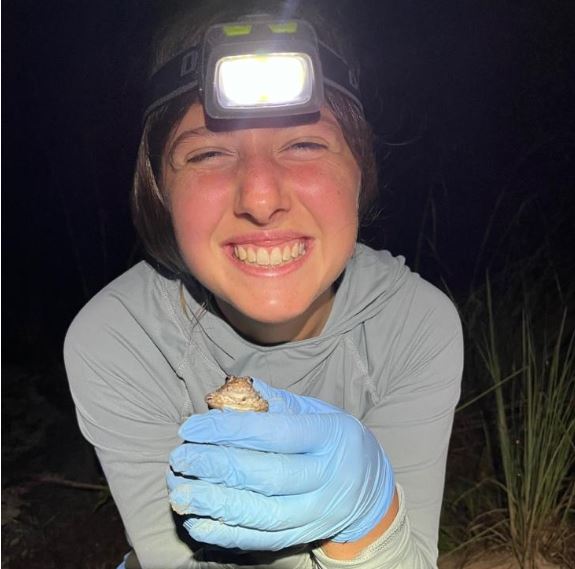
I recently completed my master’s degree under Dr. John Maerz in the Warnell School of Forestry and Natural Resources at the University of Georgia. My thesis broadly investigated the population dynamics of gopher frogs (Rana capito) within two landscapes in Georgia's Coastal Plain.
The gopher frog is a species of greatest conservation need in Georgia and pending evaluation for listing under the U.S. Endangered Species Act. Managers in Georgia are actively restoring landscapes that currently support or have the potential to support gopher frog populations. However, effective management requires an understanding of how populations function across large, complex landscapes, and that information is currently limited for gopher frogs, particularly in Georgia.
To support these efforts, the objectives of my thesis were to (1) determine gopher frog breeding occupancy in wetlands on two of the largest landscapes still supporting gopher frog populations in Georgia, (2) evaluate gopher frog genetic structure on these sites, (3) estimate genetic diversity within wetlands and genetic differentiation between wetlands, and (4) identify landscape and wetland features that appear to act as barriers to connectivity among gopher frog breeding sites.
We employed multiple capture methods as gopher frogs are a rare and cryptic species. At both sites, we conducted monthly dipnet surveys and scoped gopher tortoise burrows using funnel traps to capture gopher frogs. We also conducted bi-weekly egg mass surveys at one site. We analyzed this data using a Bayesian Occupancy model.
We collected genetic samples when an observer found any gopher frog egg mass, tadpole, juvenile, and adults during surveys from January to September 2024. When individuals or egg masses were encountered, we collected 5–10 eggs, adult toe clips, or tadpole tail clips, and preserved all samples in 95% ethanol. We extracted the DNA and genotyped samples at 10 microsatellite loci.
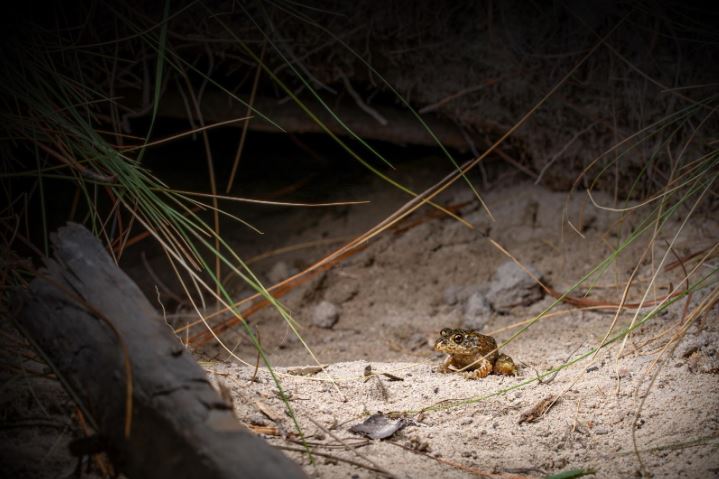
At Site A, we detected gopher frogs at 10 of the 13 wetlands surveyed and three terrestrial locations. At Site B, we detected them at only 3 of the 14 wetlands; however, we had 49 terrestrial detections. We found evidence of low genetic diversity on both sites. In addition, we found that larger landscape features such as a large creek and a highway are impeding genetic connectivity among gopher frog breeding wetlands on Site A, but overall, connectivity still appears to be fairly high. In contrast, we found clear evidence of genetic spatial structuring and limited connectivity among gopher frog breeding wetlands across Site B. We again found evidence that large landscape features (e.g. salt marsh and tidally inundated streams) likely restrict connectivity.
We also found evidence that degraded wetland conditions (i.e. closed canopies) on Site B are restricting occupancy and connectivity on the landscape. We believe that the differences in wetland occupancy and connectivity between the two landscapes are the result of differences in land use and management history. When compared to Site B, Site A had more open-canopy wetlands, which are conditions often associated with gopher frog breeding wetlands. We believe this reflects Site A’s longer history of wetland vegetation management and highlights the need for targeted canopy removal and vegetation management of wetlands on Site B (and other landscapes).