
The GTC Gopher Tortoise Day Grant was established to support educators and organizations that would like to develop a program or need funds to participate in Gopher Tortoise Day, April 10th. The goal of Gopher Tortoise Day is to increase awareness and appreciation for these long-lived, gentle reptiles. Keep reading to see how this year's Gopher Tortoise Day Grant recipients celebrated Gopher Tortoise Day!
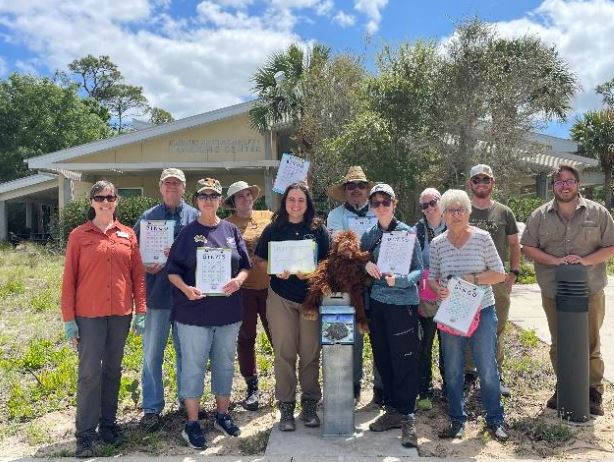
Behind the Burrow: Gopher Tortoise Day at Archbold (Nick Mauck and Rochelle Hood, Merritt Island Wildlife Association)
For Gopher Tortoise Appreciation Day, Merritt Island Wildlife Association (MIWA) had the privilege to tour and go into the field at Archbold Research Station in Highlands County, Florida. Upon arrival, Rachel Fedders, a research assistant at Archbold gave a presentation on Archbold’s conservation history. Archbold performs prescribed burns every 2-5 years on their sandhill ecosystems. Seminole tribes have done patchy burn patterns for centuries to allow a refuge for animals and have seen higher success in organism populations across the burn locations. Burns provide critical nutrient cycling and keep sandhill ecosystems free from woody plants. Gopher tortoises need well drained, sandy soil, with herbaceous plants, scattered shrub cover, and a sparce open canopy to successfully burrow. Prescribed burns help with natural maintenance and keep spaces clear for gopher tortoises to burrow. Male and female tortoises will create individual burrows, creating up to 4 different burrows a year. Burrows are approximately 10 feet (3m) deep and 40 feet (12m) long for a fully grown adult. Gopher tortoise size and burrows have been found to be correlated; the width of a burrow entrance is almost identical to the length of the tortoise.
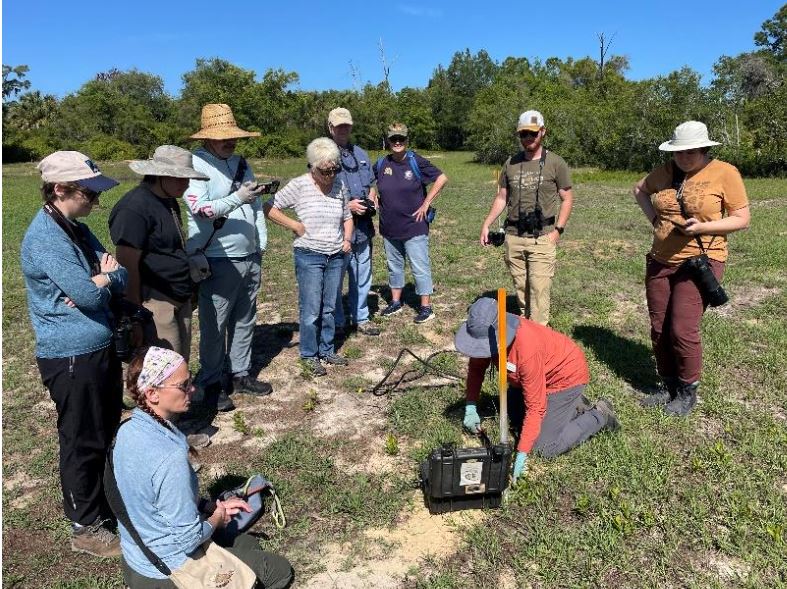
After our presentation we visited Archbold’s research site ‘The Red Hills,’ where they have been documenting, tracking, and recording gopher tortoise data since 1967. Dr. Betsie Rothermel has been researching gopher tortoises at Archbold since 2008 and is the current program director of herpetology. Dr. Rothermel engaged MIWA members on a very detailed and educational tour of her research locations. The group learned about species identification techniques, tracking protocols, and current research monitoring Upper Respiratory Tract Disease (URTD). One of the unique skills that Dr. Rothermel showed was being able to age tortoises while they were alive. Similar to counting tree rings, gopher tortoises will show growth rings on their ventrum scoots. Until the age of 10 this is an effective way to age a gopher tortoise. After 10 years old, the now adult will have worn down the scoots so that the rings cannot be identified with enough accuracy. After meeting with Dr. Rothermel, MIWA sat down with Education Program Director Dustin Angell, who shared insights into Archbold's history, conservation priorities, and long-term vision. Dustin shared insights into future research plans at Archbold, the station's connections to local Indigenous communities, and the expansion of its educational programs.
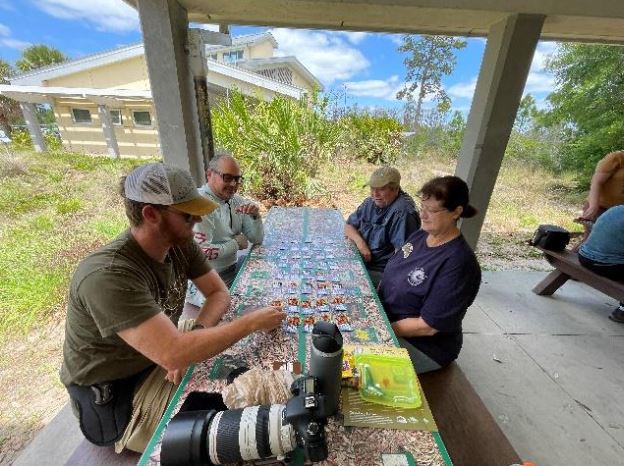
Thanks to a generous grant from the Gopher Tortoise Council program participants reinforced their learning along the journey by playing Gopher Tortoise Bingo – Habitat Edition, Gopher Tortoise Myth or Fact, and the Burrow Buddies Memory Game.
Gopher Tortoise Appreciation Day celebrates one of Florida's most important wildlife species and highlights the need to protect the habitats on which it depends. As a keystone species, the gopher tortoise supports an entire community of wildlife, making its conservation critical to the health of Florida's natural ecosystems. We thank Archbold Biological Station and the Gopher Tortoise Council for their partnership and support in making this memorable learning experience possible.
Legacy's Gopher Tortoise Traveling Trunk Makes a Strong Start (Legacy Partners in Environmental Education)
Thanks to funding provided through the Gopher Tortoise Council’s Gopher Tortoise Day Financial Assistance Grant, Legacy Partners in Environmental Education launched its new Gopher Tortoise Traveling Trunk, a hands-on educational resource designed to bring the fascinating world of gopher tortoises and Alabama’s upland ecosystems directly to schools, libraries, museums, and community organizations.
The Traveling Trunk features replicas, interpretive materials, and interactive learning experiences that help participants understand why the gopher tortoise is considered a keystone species and how more than 350 other species depend on its burrows for shelter and survival.
Earth Day at the Wetumpka Farmers Market
The Traveling Trunk and Legacy’s popular Gopher Tortoise Burrow Crawl made their debut during the Wetumpka Farmers Market Earth Day celebration. The burrow crawl quickly became one of the event’s most popular attractions. At one point, staff members had to stand at the entrance to limit the number of children entering the tunnel because so many were eager to experience life underground.
The excitement was contagious. Children emerged from the burrow sharing their discoveries.
“Hey, look at this—it’s a frog! The turtle’s his friend, and they share a home!” one young participant exclaimed.
Another excitedly pointed out, “Wow, there’s a big black snake!”
Legacy staff lost count after interacting with more than 48 children directly through the exhibit, while event organizers estimated attendance at approximately 275 visitors. Other vendors stopped by to see what all the excitement was about. The enthusiasm demonstrated the power of hands-on learning in creating meaningful connections to conservation topics and wildlife.
Featured During Alabama in Five Nature Series Launch
The Traveling Trunk was also highlighted during the launch of Legacy’s new Alabama in Five Nature Series, beginning with the inaugural booklet, TURTLES! Highlighting the Gopher Tortoise. The webinar attracted 79 participants who learned about the educational trunk, gopher tortoise conservation, and the important role these animals play in Alabama’s ecosystems.
The Alabama in Five Nature Series celebrates Alabama’s remarkable biodiversity and provides engaging science resources focused exclusively on the state’s natural heritage. Alabama ranks fourth in the nation for total biodiversity and first for aquatic species, including fish, turtles, freshwater mussels, snails, and crayfish. From the Southern Appalachian Mountains to the Gulf Coast, Alabama is recognized as a global biodiversity hotspot.
The colorful booklets in the series are designed to teach science through reading while highlighting Alabama’s unique plants, animals, ecosystems, and geological history. The Traveling Trunk will complement these materials and will be available alongside other educational resources, including the Reptiles of Alabama poster and forthcoming curriculum materials.
Supporting Educators Across Alabama
The Traveling Trunk also served as a featured resource during Legacy’s educator workshop, From Posters to Phenomena: Bringing Alabama Science to Life. Twenty educators from across Alabama gathered in Wetumpka for a two-day curriculum development workshop focused on creating standards-aligned educational materials built around Alabama-focused science content.
Using Legacy’s poster series as a foundation, participants collaborated to develop new activity guides and lessons that connect science concepts to real-world phenomena and local environmental topics. These resources will be made available to educators throughout the state.
Special thanks go to the workshop facilitators and content experts, including Sierra Stiles of Turtle Point Science Center, Shirley Farrell of the Alabama Ornithological Society, Britney Furleigh of AMSTI, Tracey Carter, and Dr. Bill Deutsch, for sharing their expertise and guiding this collaborative effort.
Early Success and Growing Demand
The Traveling Trunk is already generating interest beyond its initial launch events. After seeing the Gopher Tortoise Burrow Crawl at the Wetumpka Farmers Market Earth Day event, representatives from the Kelly Fitzpatrick Center for the Arts booked a Keystone Species program for July and specifically requested the Gopher Tortoise trunk exhibit as part of the presentation.
In just the first two months following its launch, Legacy has shared the story of the gopher tortoise with at least 374 participants through public programs, webinars, educator workshops, and community events. Additional programs are already being scheduled, demonstrating strong demand for engaging, hands-on conservation education.
As the Traveling Trunk becomes available for checkout across Alabama, Legacy anticipates reaching hundreds more students, educators, and community members each year while fostering appreciation for gopher tortoises and the vital role they play in Alabama’s upland ecosystems.
Legacy is grateful to the Gopher Tortoise Council for its support and for helping expand conservation education opportunities that inspire appreciation for the gopher tortoise and Alabama’s extraordinary natural heritage.
Gopher Tortoise Day at the Troy University Arboretum (Troy University Naturalist Club)
The Troy University Naturalist Club was awarded the Gopher Tortoise Day Grant of $1035.85 through applicant Sydney Bernard with the assistance of Fisher Parrish, Adele Crabtree, and Dr. Alvin Diamond. With the support of the Gopher Tortoise Council’s grant, the club was able to facilitate a Gopher Tortoise Day outreach event at the Troy University Arboretum on April 10, 2026. By partnering with the Montgomery Zoo, there were live animals at the event, including a gopher tortoise, hawk, opossum, snake, and various insects.
The event had various stations beyond the live animals from the Montgomery Zoo. The front room of the Troy Arboretum was dedicated to crafts. Children and visitors were able to complete different activities from the packet seen below, including a Gopher Tortoise Day paper mosaic craft, multiple gopher tortoise coloring pages, and a gopher tortoise word search. With tissue paper, glue, markers, googly eyes, and more, participants brought their creative visions to life with the help of Troy Naturalist Club volunteers. A Troy Naturalist Club member also ran a face-painting station that she had done at a previous club event, and it was a hit once again!
In the main room of the Troy Arboretum, a station comprised of a Gopher Tortoise Burrow fort was situated on the right side of the room. This realistic model allowed attendees to crawl inside and see what a gopher tortoise’s home is really like. Toy models of various species that rely on gopher tortoise burrows were placed inside the burrow, including snakes and a gopher tortoise statue. Children enjoyed exploring it with flashlights.
Additionally, there was a gopher tortoise game station. Participants played trivia games, planned and executed by Naturalist Club members, on all things gopher tortoise! There were also story times and opportunities to read the award-winning book, At Home with the Gopher Tortoise: The Story of a Keystone Species. This book has outstanding illustrations and has won the Moonbeam Children’s Book Award, National Science Teachers Association (NSTA) Trade Book Award, and Nautilus Book Award.
The estimated attendance of the event was around 75 people with clientele ranging from young children and families to police officers, college students, adults, and older naturalists. It even led attendees outside of the university to inquire about joining the club! The event garnered fantastic turnout from the local community in Pike County-an area where the gopher tortoise is a native keystone species. Attendees were also given free gopher tortoise stickers to take home as a reminder of this outreach event.
In addition to the Gopher Tortoise Day outreach event, grant funding was used to create and install permanent signage at the Troy University Arboretum. This signage is intended to inform visitors about the gopher tortoise, a keystone species in the very county they are standing in!
Gopher Tortoise Day Eco-Festival in Placida, Florida (Bocilla Islands Conservancy, Inc.)
On behalf of Bocilla Islands Conservancy, thank you for awarding us a $1,500 Gopher Tortoise Day Grant. Your support made it possible for us to host a community education festival focused on increasing awareness of the ecological importance of gopher tortoises and strengthening stewardship of this keystone species on a bridgeless barrier island.
During the event, we provided education about the role of gopher tortoises as a keystone species whose burrows support dozens of other native animals that depend on them for shelter and survival. Participants learned how tortoises forage along roadside edges, travel in search of water, and move through developed island landscapes, increasing their vulnerability to vehicle strikes in areas with limited habitat corridors.
One of the focuses of the program addressed the impacts of new residential construction on tortoise habitat. We shared guidance about how site clearing affects burrow systems, what permitting considerations may apply when burrows are present, and how early coordination can help prevent harm to tortoises while keeping projects compliant with wildlife protection standards. Residents were also introduced to the Conservancy’s free support services, including guidance related to burrow identification, construction planning awareness, and coordination with wildlife response partners when assistance is needed.
The program also highlighted the unique conservation challenges facing island populations. Because there is no bridge connection allowing movement between mainland habitats and the Bocilla Islands Chain, local tortoise populations cannot easily be supplemented by migration. We discussed how recent hurricanes, including Hurricanes Ian, Helene, and Milton, brought storm surge and repeated flooding across Southwest Florida that may have affected burrow stability, reduced forage availability, displaced individuals, and increased mortality risk. These conditions make protection of remaining habitat especially important for long-term population resilience on the island.
Participants were also introduced to our volunteer Gopher Tortoise Conservation Team and our island wildlife response coordination network, which assists residents in reporting concerns and connecting with appropriate rescue partners. These services help reduce accidental disturbance during construction and landscaping activities and improve outcomes for tortoises encountered by property owners.
The event featured conservation practitioners and experienced volunteers who helped answer community questions about habitat stewardship, permitting awareness, burrow protection practices, and responsible coexistence with gopher tortoises in a changing coastal environment.
Support from the Gopher Tortoise Council made it possible for us to deliver locally relevant education that strengthens long-term stewardship of gopher tortoises and their habitat on the Bocilla Islands Chain. We are grateful for your partnership and for helping us expand conservation awareness where it is most needed.